



Inequality in selection processes
A study by the UPV, CSIC and UV reveals unconscious biases that favour men in hiring and promotion for leadership positions.
[ 02/10/2025 ]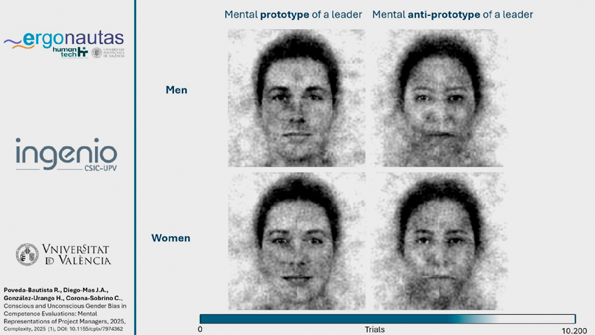
A team of researchers from the INGENIO Institute, a joint centre of the Spanish National Research Council (CSIC) and the Universitat Politècnica de València (UPV), from the Ergonautas group of the HumanTech Institute of the UPV and from the University of Valencia has detected unconscious biases that favour the hiring of men for leadership positions. The study reveals differences in how skills such as leadership, problem-solving, and experience are perceived, depending on whether the face is that of a man or a woman.
These are the main conclusions of the article ‘Conscious and Unconscious Gender Bias in Competence Evaluations: Mental Representations of Project Managers,’ recently published in the scientific journal Complexity.
The evidence that there is a gender difference in hiring for leadership positions is thus supported for the first time by a technique called NBRC (Noise-Based Reverse Correlation), which allows the mental prototypes that people use to judge whether someone fits a leadership position to be transformed into real images, human faces representing a man or a woman.
'In previous studies, when attempts have been made to confirm gender bias in cases of recruitment for management or project management positions, survey systems and conscious questioning have been used. Due to their very nature, these systems cannot reveal unconscious biases, which are present when any decision is made,' explains José Antonio Diego Más, director of Ergonautas (Human-Tech, UPV). 'What this innovative application of the technique has now allowed us to do is to transform into a real image the sum of the mental prototypes that project managers use when judging the competence of a candidate for a management position. In this way, we have made physical the mental image of the ideal leader, that is, the one we unconsciously use to judge who we choose for a leadership position,' adds the researcher.
‘The NBRC technique is often used in sociological studies and has been used for psychological assessments linked to boards and/or to predict who will win elections, with a high degree of reliability,’ explains José Antonio Diego.
In this case, the Ergonautas and INGENIO team surveyed more than thirty professionals (men and women) belonging to the Spanish Association of Project Management and Engineering, a member of IPMA (International Project Management Association). Using NBRC, a total of 10,200 responses were obtained from all participants, and the characteristics of their choices were transformed into two faces: one generated from the responses of men and the other generated from the responses of women. 'Afterwards, we also asked the same survey participants whether they perceived the faces as male or female,' explains Rocío Poveda, a researcher at INGENIO. In addition, they were asked about various aspects related to the skills required for these management positions, such as leadership, negotiation, conflict resolution, interpersonal communication skills, teamwork, reliability, problem-solving skills, and experience, among others.
The study suggests that there is a need to improve the selection processes.
The results of the study reveal very significant differences in this regard. In the surveys conducted with men, the skills of experience, leadership, and problem-solving were perceived as more prevalent in the male face. However, emotional skills (personal communication, negotiation, conflict resolution, relationships and involvement) were predominantly associated with the female face among all respondents.
Rocío Poveda, a researcher at INGENIO (CSIC-UPV), explains that "there is clear evidence that the decision-making bodies in certain professions are predominantly made up of men. Based on this premise, when a conscious assessment is requested for management positions, many of the necessary skills are more clearly recognised in faces perceived as female. However, the mental prototypes revealed by the study and the evident influence of unconscious biases in decision-making lead us to conclude that these inequalities in access to leadership positions persist."
The study suggests that selection processes should be better structured (preliminary criteria, blind phases where possible, increasing diversity in evaluation panels and balancing gender representation) to correct biases that would otherwise ‘remain invisible,’ says Poveda. ‘By bringing these patterns to light, this study provides operational evidence for redesigning procedures and improving equity in professional careers,’ adds the INGENIO (CSIC-UPV) researcher.
Outstanding news
 Study a degree at the best technological university in Spain
The Universitat Politècnica de València is ranked number 1 among Spanish technology universities, according to the Shanghai ranking
 National Research Award
Ramón Martínez Máñez has received the "Juan de la Cierva" National Research Award in the area of Knowledge Transfer
 The UPV and Beihang University strengthen their academic and scientific alliance
The two universities have signed a new collaboration agreement as part of the celebration of "UPV Day" in China
 Study in English
The UPV offers eight degrees, 16 master's and 650 courses in English for the 2025-26 academic year
 THE Impact Ranking
The UPV, the Spanish university with the greatest social and economic impact in the world

