

At temperatures of up to -200 ºC
UPV researchers develop a new refrigeration system that allows the preservation and transport of vaccines or other medical material
[ 23/12/2020 ]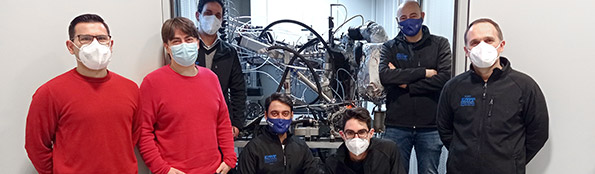
Researchers from the Universitat Politècnica de València (UPV) have developed a new Stand-alone ultracold system (Ultracold Stand-alone Container or CAU) that allows the transport of vaccines against COVID-19 that require very low temperatures. The system is capable of reaching -200 degrees centigrade, exclusively using fresh air as cooling fluid.
The Ultracold Stand-alone Container (CAU) has been developed by experts from the CMT-Thermal Engines Institute, and is scalable for all types of chambers, from medical-pharmaceutical material delivery vans to industrial refrigerators, large merchandise containers, or storage and distribution logistics centres.
"The entire process of both transport and storage of vaccines could be covered, ensuring at all times that the chambers are kept at the required temperature to guarantee their correct preservation", highlights Vicente Dolz, researcher at the CMT-Thermal engines of the UPV. The system reaches up to -200 ºC stably. It is a 100% stand-alone system, with electrical power.
An alternative to dry ice
The latest technologies applied to the manufacture of vaccines involve the preservation of genetic material of the virus at cryogenic temperatures (-70 °C). The current solution is to use dry ice (which sublimates at -78 ºC) or liquid nitrogen (which evaporates at -196 ºC) to refrigerate the vaccine containers.
However, according to the researchers of the CMT-Thermal Engines of the UPV, this technology has some drawbacks: it is hard to control the temperature and the vials, which, if subjected to extreme temperatures, can become damaged; in certain transports such as airplanes, the CO2 from dry ice that sublimates in the cabin may be dangerous. In addition, a lack of dry ice supply is expected due to the shortage of pure CO2 production.
"The current health emergency situation and new vaccine manufacturing techniques require new refrigeration techniques at very low temperatures. The industrial and fiscal limitations for the manufacture and commercialization of traditional refrigerant fluids make it necessary to look for new ultra-refrigeration technologies that are efficient, and, at the same time, environmentally friendly, and that minimize CO2 emissions. And that is the need that the system that we have devised in our laboratories addresses”, points out José Ramón Serrano, a researcher at the CMT-Thermal Engines of the Universitat Politècnica de València.
How are those temperatures kept?
“In order to maintain the cold chain in the transport of vaccines, the expansion of the air is used in a reverse Brayton cycle. By controlling the rotation speed of the cycle compressors by means of a frequency converter, the power and therefore the process temperature is controlled”, explains José Ramón Serrano.
As the vaccines already arrive in insulated boxes loaded with dry ice, the CAU only has to keep the cold chain by compensating for heat losses to the environment. This enables the indefinite storage or transport of the vaccine boxes, within the CAU chamber, and without the need to replenish or monitor the dry ice. “You just have to feed electrical power to the machine. It could also be an alternative to dry ice if the CAU were used to store the vaccines already at their production centre”, concludes Serrano.
The team of the CMT-Thermal Engines of the UPV has a prototype of the CAU fully instrumented and in operation on one of the test benches of its laboratories
Outstanding news
 Study a degree at the best technological university in Spain
The Universitat Politècnica de València is ranked number 1 among Spanish technology universities, according to the Shanghai ranking
 Highly Cited Researchers 2025
Avelí Corma, Juan Bisquert and Luis Guanter, the international scientific elite with a Universitat Politècnica de València hallmark
 Historic Milestone in Spanish Higher Education
The UPV inaugurates the Beihang Valencia Polytechnic Institute, the first Spanish university center in China
 Study in English
The UPV offers eight degrees, 16 master's and 650 courses in English for the 2025-26 academic year
 A Latin Grammy... with the UPV hallmark
'Music teaches us to listen and live together,' says Rafael Serrallet, Doctor of Music at the UPV, awarded in Las Vegas as the author of the Best Instrumental Album of 2025
 THE Impact Ranking
The UPV, the Spanish university with the greatest social and economic impact in the world